 Bested
- 🟥 Red 94/121
- 🟦 Blue 78/121
🃏Crib
A 400-year-old card game with its own little racetrack — and a hand nobody ever gets.
▶️ Play Crib on BestedFree · keep score, challenge a rival, tell the story
Cribbage is a card game for two to four players in which you score points by making combinations — fifteens, pairs, runs — and keep score by moving pegs around a small wooden board, first to 121 wins. It is more than 350 years old and still has a loyal following in Canada, the US and the UK.
1. How to play
- 🎯 The goal
- Be the first to move your peg 121 holes along the cribbage board — points come from adding cards to 15, pairs and runs.
- 👥 Players
- 2–4
- ⏱️ How long
- About 1 h
- 🎒 You need
- Deck of cards, Crib board & pegs
🧰 Set up
- 1Grab a normal 52-card deck and a cribbage board. Aces are worth 1, face cards (J, Q, K) are worth 10, everything else is its number.
- 2Everyone cuts the deck — lowest card deals first. The deal swaps every hand.
- 32 players: deal 6 cards each. 3 players: 5 cards each, plus 1 card face down into the crib. 4 players (two teams): 5 cards each.
- 4Everyone picks cards to throw face down into the “crib” — 2 cards each with 2 players, 1 each with 3 or 4 — so the crib always has 4. The crib belongs to the dealer and is scored at the end of the hand.
- 5You keep 4 cards. The player left of the dealer cuts the deck and the dealer flips the top card face up: the “starter”. (Turned a jack? The dealer pegs 2 — “his heels”.)
👥 With 2 players
- Deal 6 cards each. Each of you puts 2 cards into the crib, and keeps 4.
- One peg track each — it's you against them. After the crib there are 4 cards in your hand and 4 in theirs.
- The non-dealer leads the play, counts first, and the dealer takes the crib.
👥👤 With 3 players
- Deal 5 cards each, then deal 1 extra card face down from the deck straight into the crib. Each player then puts 1 card into the crib (so it has 4 again) and keeps 4.
- Everyone plays for themselves with their own peg — a three-lane board, or a board with one extra pair of pegs.
- Play and counting go clockwise from the player left of the dealer. The dealer counts last, and takes the crib.
👫👫 With 4 players
- Deal 5 cards each. Each player puts 1 card into the crib (4 cards) and keeps 4.
- You play as PARTNERS: sit opposite your partner, and share one set of pegs between you. Your scores add up, and either of you can win it for the side.
- Play goes round the table clockwise — partners may NOT show or tell each other their cards. The crib belongs to the dealer, and its points go to the dealer's side.
- (No partners? Four players can also play every-man-for-himself with four pegs. Same deal, just no teams.)
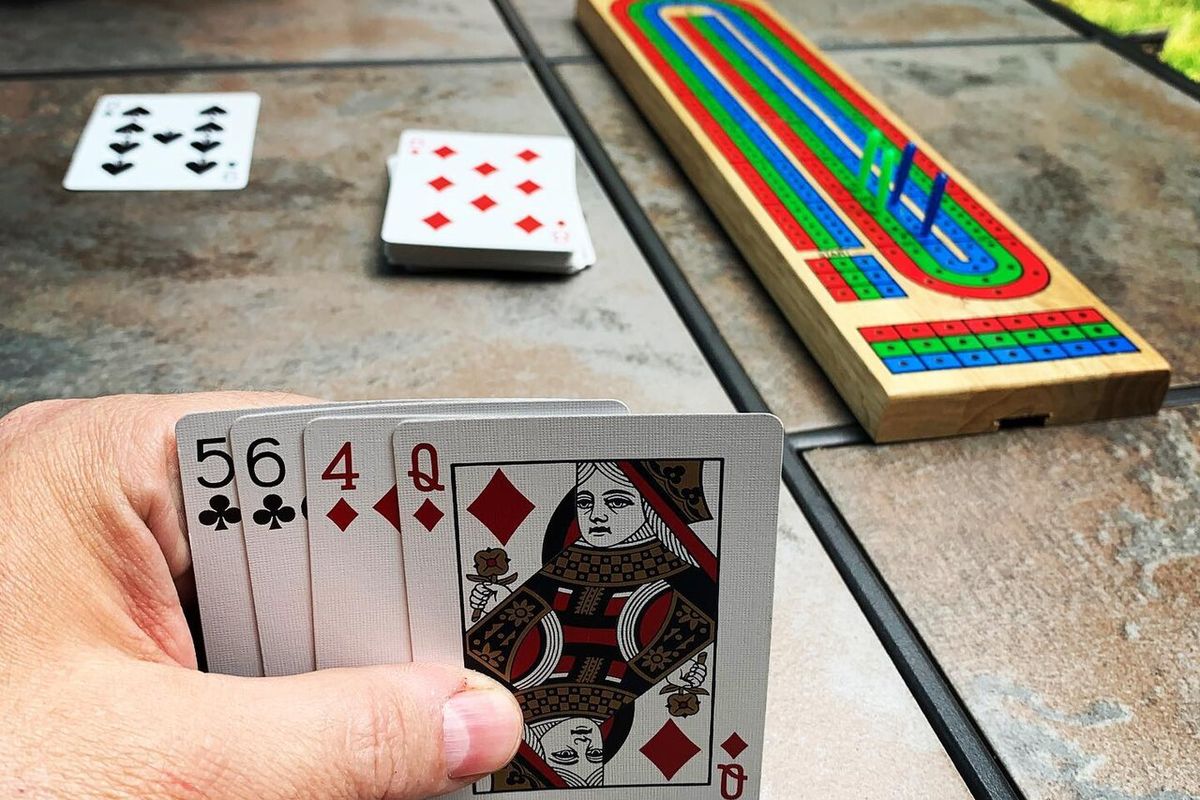
🔁 How a turn goes
1 · Play cards and count up (pegging)
Take turns putting one card face up in the middle and say the new total out loud. Example: you play a 7 (“7”), your rival plays an 8 (“15 — that's 2 for me!”). You score points the moment you play: • Total hits exactly 15 → 2 points • Total hits exactly 31 → 2 points • Same number as the card just played (a pair) → 2 points • Three the same in a row → 6 points • Three or more in number order, like 4-5-6 → 1 point per card
2 · Can't play? Say “Go”
The total can never go past 31. If every card you hold would push it over, say “Go”. Your rival keeps playing if they can. Whoever plays the last card scores 1 point (2 if it lands on exactly 31). Then the total goes back to 0 and you keep playing the cards that are left.
3 · Count your hand (the show)
Once all cards are played, pick your 4 back up and add the starter card in the middle — that's 5 cards to score. • Every group adding up to 15 (7+8, 5+K…) → 2 points • Every pair → 2 points • Every run of 3 or more (9-10-J) → 1 point per card • 4 cards of one suit in your hand → 4 points (5 if the starter matches) • The jack in the same suit as the starter (“nobs”) → 1 point The player who didn't deal counts first.
4 · The dealer's bonus: the crib
The dealer flips over the crib (the cards everyone threw away) and scores it just like a hand — those points are the dealer's alone. Then the deal swaps and you play the next hand.
🏆 How you win
The first player to reach 121 wins — even in the middle of a hand, the moment the peg lands. Finish before your rival is past 90 and that's a “skunk”: double the bragging rights. (Short game: first to 61.)
💡 Tips from the sore losers
- Keep cards that make 15 together (a 5 with a 10, J, Q or K is gold) and throw your rubbish into your rival's crib — not yours.
- Never lead with a 5. Your rival will happily add a face card and say “15 for 2” with a smug little smile.
- “Fifteen two, fifteen four, and a pair is six” — say it out loud. Counting is half the fun (and the arguments).
🙋 Quick questions
Who deals first?›
Everyone cuts the deck. Lowest card deals first (ace is low). After that the deal swaps every hand.
Who plays first when pegging?›
The player who did NOT deal (to the dealer's left) plays the first card. The dealer always plays last.
Who counts first?›
The player who did NOT deal counts their hand first. Then the dealer counts their hand, then the dealer counts the crib. (It matters near 121 — the first to count can win before the dealer gets to count.)
Who cuts the starter card?›
The player to the dealer's left cuts the deck, and the dealer flips the top card of the bottom half face up.
What's “his heels”?›
If the starter card flipped up is a jack, the dealer pegs 2 points straight away.
What's “nobs”?›
Holding the jack of the same suit as the starter card in your hand (or the crib) is worth 1 point when you count.
What does “Go” mean?›
You can't play without going past 31, so you say “Go”. Your rival keeps playing if they can; whoever plays the last card scores 1 (2 for exactly 31). Then the count restarts at 0.
Does the starter count for flushes?›
In your hand, 4 cards of one suit = 4 points (5 if the starter matches). In the crib, ALL 5 cards must be the same suit.
Can you win in the middle of a hand?›
Yes — the moment your peg reaches 121 (or 61 in a short game) you win, even while pegging.
2. Why play it
- Quick mental maths — you'll be adding to 15 faster than a calculator
- Memory and planning: remembering what's been played
- A game that bridges generations — grandparents love teaching it
3. History
📍 England, early 1600s — usually credited to the poet Sir John Suckling, who is said to have adapted an older game called Noddy.
🧑🔬 Who made it: Sir John Suckling (1609–1641) — a Cavalier poet, playwright and courtier at the court of Charles I, as famous for his gambling and his wit as for his verse. Tradition says he adapted the older game Noddy.
Cribbage is one of the few card games that has kept the same scoring board for centuries: a wooden track with two pegs per player, racing to 121.
It spread from English taverns to ships and then across the world; today it is especially loved in Canada, the US and the UK, where it's played at kitchen tables, in pubs and in clubs.
The cards you throw away to the 'crib' go to the dealer, which is where the game gets its name — and its strategy.

1500s
A card game called Noddy, which uses a pegging board and a 'nob', is played in England — the likely ancestor of cribbage.
1630s
Sir John Suckling is credited with turning Noddy into cribbage, adding the crib (the dealer's extra hand).
1674
Charles Cotton's The Compleat Gamester prints rules for cribbage — one of its first appearances in a book.
1700s–1800s
Sailors and soldiers spread the game around the world; shipboard boards are carved from whale ivory and bone as scrimshaw.
1800s
Cribbage becomes a kitchen-table classic in North America, with boards of wood, brass and later plastic.
Today
Clubs, leagues and tournaments run in Canada, the US and the UK, and a digital board in your pocket works as well as a wooden one.
4. Variants
- Six-card cribbage
- The standard game for two players: each is dealt six cards and throws two into the crib.
- Five-card cribbage
- The older version: five cards each and a shorter game, usually to 61.
- Three- and four-player
- Three players add an extra card to the crib; four play as two partnerships.
5. Cultural impact
Cribbage is one of the few card games that is also an object: the board. Families hand cribbage boards down the way they hand down watches, and a good one carved by a sailor or a grandfather is a keepsake.
It is a social game by design — the counting out loud ('fifteen two, fifteen four, and a pair is six') is half the fun, and so is the friendly smack talk when someone skunks you.
6. Words it gave us
- “Peg out”
- To finish or to die is thought to come from pegging out at the end of the board.
7. Famous faces & records
- ⭐ Sir John Suckling — the poet and courtier usually credited with inventing it.
- The perfect hand is 29 points: three fives and a jack of the starter's suit, with the fourth five turned up. About 1 in 216,000 hands.
8. Did you know?
- 🤓 The best possible hand is worth 29 points: three fives and a jack, with the fourth five turned up as the starter card.
- 🤓 Being dealt a 29 hand is roughly a 1-in-216,000 event, so most players go a lifetime without one.
- 🤓 Finish before your opponent reaches 91 and you've 'skunked' them; stay under 61 and it's a double skunk.
- 🤓 Holding the jack of the same suit as the starter card scores 'his nobs' — a one-point tip of the hat.
🏷️ Also called: Cribbage · Crib
📷 Photos: J Wynia from Minneapolis, United States · CC BY 2.0 · Wikimedia Commons
Keep score of Crib on Bested
Live scoring, challenges with your people, smack chat and a memory book for every game. Free to play.